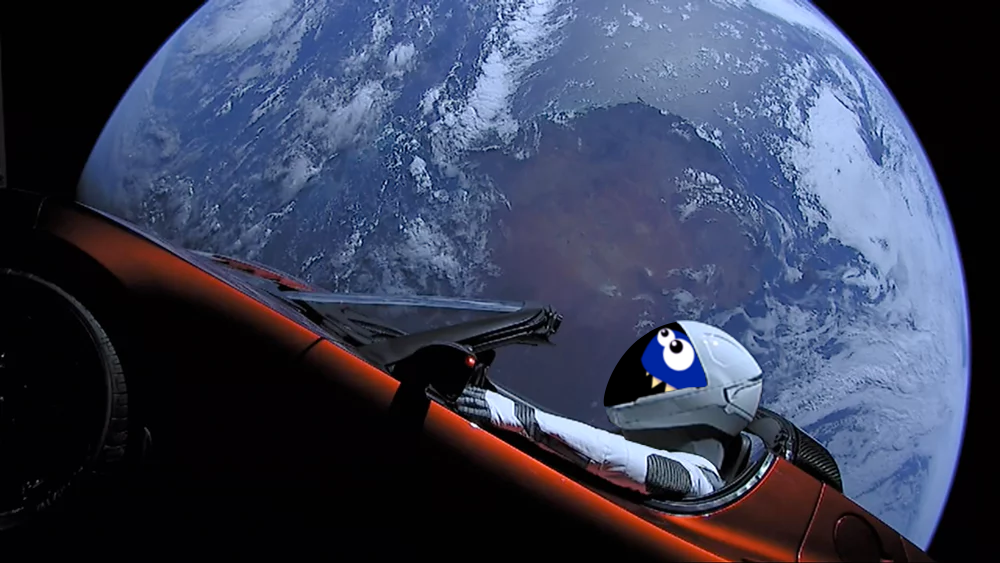
During early February, SpaceX, ElonMusks’s Aerospace company, created history by sending their flagship rocket – the ‘Falcon-Heavy‘, into space. Its claim-to-fame is not the fact that this is the most powerful rocket currently in service, but that it is the first partially reusable one. The Falcon Heavy can reuse its stage 1 side-boosters & Titanium grid fins thereby greatly cutting the cost for future rocket launches. Each flight of the rocket will cost only $90 million as opposed to the next most powerful rocket (Delta IV Heavy) which runs up to approximately $350 million. Musk’s vision for SpaceX included everything from Inter-planetary travel, Mars colonisation to Asteroid Mining. The successful launch of the Falcon Heavy was a powerful reinforcement of this vision.
One of the most notable occupants of the rocket was Elon’s personal cherry-red Tesla Roadster which has gained a sort of celebrity status. There is even a website that does real-time tracking on the roadster’s current position in space. Through this article, I wanted to throw light on a more mysterious occupant who got greatly overshadowed by the Tesla. The tiny yet significant object is a data crystal simply known as Arch (pronounced as ‘Ark’).
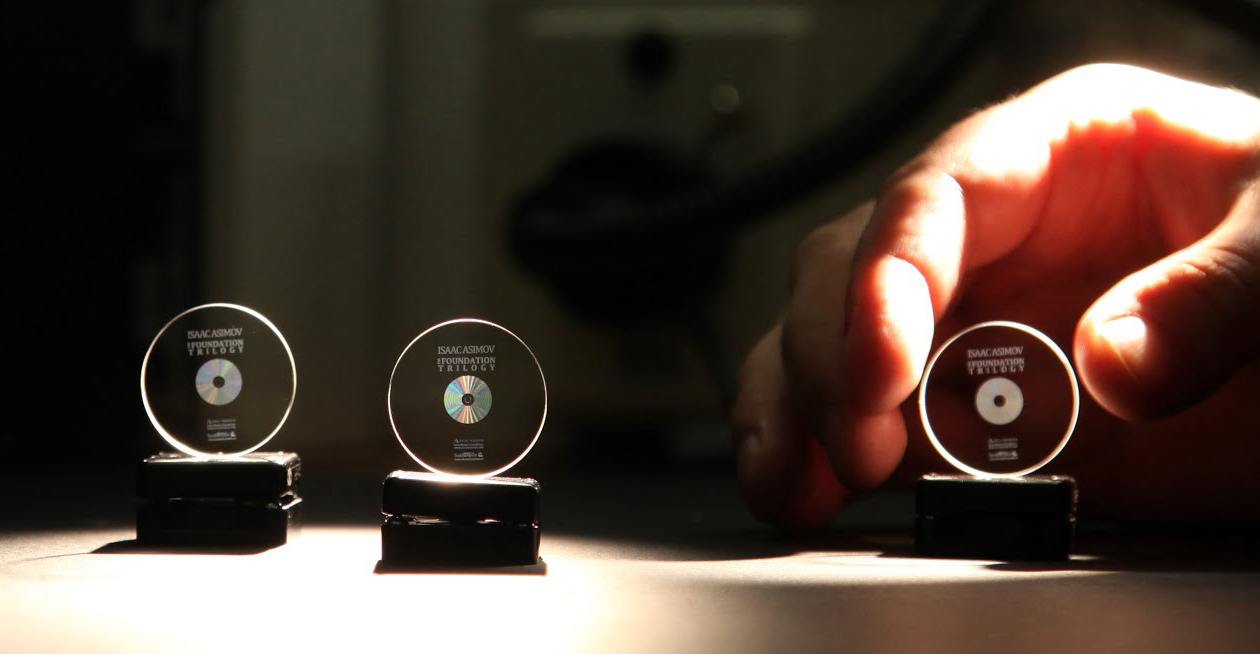
The Arch discs are Quartz crystals small enough to be mistaken for a coin, but could theoretically store up to 360 Terabytes of data. But that’s not all – its physical structure ensures that it could last up to 14 billion years in the harshest of conditions in space. The discs make use of quartz silica re-structuring technology using powerful 5D optical lasers to achieve these stunning storage capabilities. Caught your attention yet?
These discs are manufactured by Arch Mission, an NGO which is the brainchild of Dr Peter Kazansky from the University of Southampton. Their main objective as described on their website is
‘to disseminate a large network of Arch™ Libraries across the solar system which will guarantee preservation of human data, no matter how much information humans create, for as long as the solar system exists. ‘
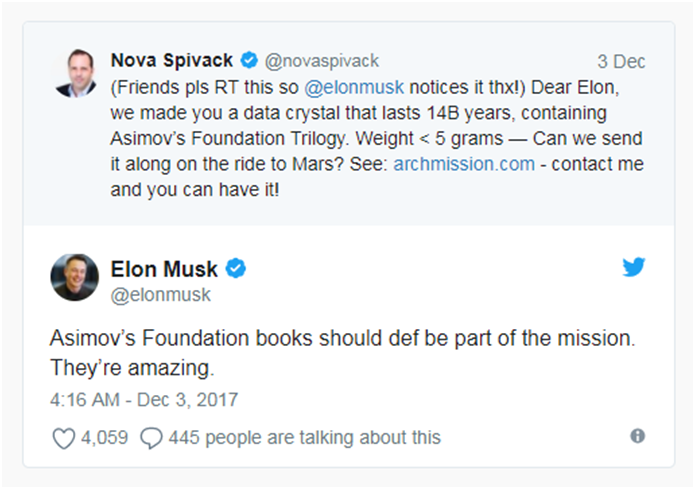
It all started with a very casual exchange between Musk and the co-founder of the Arch Mission through twitter, which resulted in Musk getting obviously excited and onboard to send the disc to space.
If you are curious to know how this technology works, let’s first have a look at how normal CDs work. All CDs essentially have small ‘Bumps’ and ‘flat’ surfaces arranged in a spiral line. When a laser beam is run through the line, it registers these bumps as 1s and flat surfaces are 0s. This is a traditional two-dimensional data storage system using bumps and flats. This will also explain why data loss on CDs is quite common as the surfaces are prone to scratches or disfigurement through humidity and heat, thereby making it harder to differentiate these bumps and flats.

In contrast, the Arch discs use tiny structures similar to the bumps, called ‘Nano-Gratings’. These gratings are far more complex than simple bumps and flats, refracting light in five orientations, hence providing 5-dimensional data storage. When running a laser through these gratings, different orientations of light, its strength as well as its location on the X, Y and Z axes could be interpreted & utilized as different dimensions for storing data. Thus, these discs can store data at a much higher density than normal CDs. In terms of durability, these nano-gratings are stored within its interior surface.The exterior being quartz glass is extremely tough. It is also chemically stable and can safely function up to temperatures of 1000°C. This chemical stability meant it will not fall prey to oxidation like normal CDs.
The quartz form is just version 1.1 and 1.2 of Arch Discs. They are also conducting research on other storage mediums such as
- Nickel ion-beam atomic-scale storage
- Molecular storage on DNA molecules
- Durable space-based flash drive storage
- Quantum information storage etc.
What is the end-goal to all this? As per their website
“As we spread beyond Earth we must develop the means take our data and knowledge with us, in a form that can survive in space, and on new worlds. As we grow into an interplanetary species and civilization, we must find ways to connect and share our knowledge and data across the solar system.”
If you’re interested to know more please find information on their official website as well as articles here & here from where I’ve stolen info for this article :-).
Generally I do not read post on blogs, but I wish to say that this write-up
very forced me to check out and do it! Your writing taste has been surprised me.
Thank you, very great article.
https://waterfallmagazine.com
Hey! I know this is kinda off topic however I’d figured I’d ask.
Would you be interested in trading links or maybe guest writing a
blog article or vice-versa? My blog addresses a lot
of the same subjects as yours and I feel we could
greatly benefit from each other. If you are interested feel free to shoot me an e-mail.
I look forward to hearing from you! Great blog by the way!
Hi i am kavin, its my first time to commenting anywhere, when i
read this paragraph i thought i could also create
comment due to this brilliant piece of writing.