
Word of caution: The content being expressed below are my own interpretations of the information available online regarding the Feather re-entry system (references provided at the end). I’m in no way for form, an expert in this field.
Introduction
Richard Branson and Virgin Galactic made history on 11th July 2021, by successfully completing arguably world’s first commercial ‘space-tourism’ flight. The spacecraft VSS Unity containing 2 pilots and four passengers, flew to an altitude of around 83 kilometers, with the crew experiencing 4 minutes of weightlessness before gliding safely back down to earth. The complete round trip took approximately an hour. Although there are so many things around the flight that are worth discussing, one aspect that fascinated me the most was its re-entry back to earth using the spacecraft’s Feather technology. In this article, through a layman’s perspective, I wanted to touch upon how the Feather enabled a spacecraft to safely re-enter earth’s atmosphere.
Atmospheric Re-entry
Before we proceed, I think it’s important to try and grasp what Atmospheric Re-entry is, and why it is such a big deal. If you are like me, you’d be inclined to think the hard part of the job is fighting Earth’s gravity and getting the rocket to space, while bringing it back should be simple, as it’s just going to fall down with gravity (or so I thought – and boy was I wrong).
Allow me try and illustrate the importance of re-entry with a simple example even 5-year-olds would be able to associate with: Skipping stones on the surface of a lake. We’ve all indulged in this simple pleasure, trying to show off how many times we can make stones bounce on the water surface. As we get better at it, we start to understand that a flatter stone, thrown at sufficient speeds, in a particular angle gives the biggest number of bounces. However, if the stone is too heavy, or too slow, or the angle of impact is too steep, then the stone just makes a big splash and sinks quickly. A spaceship re-entering the Earth’s atmosphere faces a similar dilemma as it is trying to move from a less dense medium (space) to a much denser, ‘fluid-esque’ medium(Earth’s atmosphere) which behaves almost like the water surface.
If the spaceship is entering too fast, or at too steep an angle, they risk making a ‘big splash’ or in this case disintegrating the spacecraft in a glorious fireball. On the other hand, if the spacecraft is too slow, or the angle of entry too gentle, then it risks hitting the atmosphere and just bouncing off of it like a skipping stone. So now you can understand why it is important for the space craft to move at a particular speed and angle to re-enter earth’s atmosphere with as much grace as possible without ending up in a fireball.
Although there are multiple considerations while defining the re-entry for the spacecraft, some of the main ones are
- Deceleration: Getting a spacecraft down to Earth involves decelerating an object traveling at a little over 28000Kmph all the way down to 0 at rate which should neither be too high, nor too low. Each spacecraft and its inhabitants have a maximum limit of deceleration it can withstand before crumpling up like paper, so the rate of deceleration cannot be too high. On the other hand, too little deceleration can also lead to the issue of the spacecraft just ‘hopping’ off of the atmosphere.
- Heating: Remember that we are trying to bring a fast moving object (high kinetic energy) from up in space (high potential energy due to its altitude) all the way back to sea-level within a very short span of time. Law of conservation of energy says energy can never be created nor destroyed, so where do you think all this energy is going :)? All this energy is getting dissipated in the form of heat caused by the friction in the atmosphere, against the body of the spacecraft.
Fun-fact: the surfaces of the spacecraft can go up-to 1477°C on a normal re-entry.
- Accuracy of landing: This is also a point of consideration as to where and how the spacecraft is going to land. The ‘capsule’ type space crafts have no control over where it lands as its descent is usually just parachute assisted, whereas winged spacecraft have the capability of controlling their descent and landing in a pre-determined landing strip. PS: Let the fact sink in that the winged crafts have the ability to descend from more than 6000 kilometers up in space to land accurately on a 100 meter runway!
Existing re-entry vehicles could be broadly categorized as
- ‘Capsule’ shaped spacecraft that just drops to earth assisted by parachutes.
- ‘Winged’ spacecraft or space shuttles that can fly/glide down
A quick comparison between the two provided below.
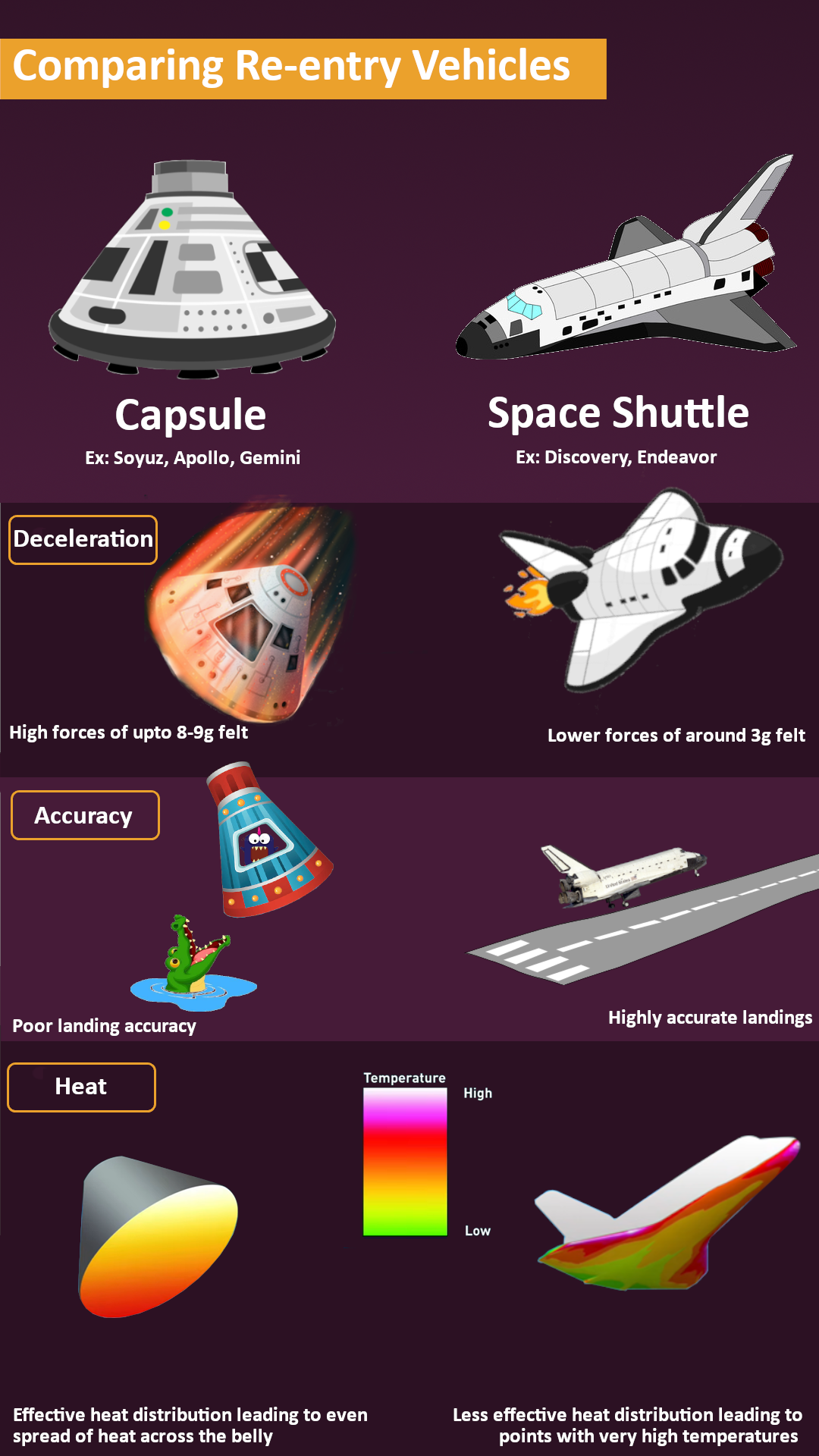
From the comparison, it is clear that each type of re-entry has its own advantages and disadvantages at different points in the flight. The capsule type of crafts have self-orienting body shapes, so during re-entry, capsules can enter through a wider range of angles and speeds knowing it can effectively re-orient itself. They are also better at distributing friction heat uniformly across its belly. However the g-forces felt in capsules are quite high. Its landing accuracy is also very poor, so it’s difficult to judge where the craft is going to land. The winged shuttles, on the other hand, are required to fly in to the atmosphere at a very specific angle and speed so that it enters with its body perfectly oriented. The heat distribution is also not uniform, with certain points (eg: Nose) on the craft heating to a much higher degree than others. However, post re-entry, the Space shuttle behaves like a normal aircraft with the ability to steer and land on a predetermined air strip.
So as you can see, re-entry to earth requires as much consideration for a spacecraft as lift-off!!
Feathered re-entry
The Feathered re-entry was first suggested in 1958 by Dean Chapman. He simply described it as employing a large, light, drag device during the initial descent, thereby minimizing control requirements during entry. Once velocity is reduced, the drag device could be retracted for the remainder of the descent.
VSS Unity, the Virgin Galactic spacecraft makes use of rotating wings/tail booms on the Spacecraft for a ‘Feathered’ re-entry back into the earth’s atmosphere. Through this technology, the VSS Unity tries to bring in the best of both worlds and make the spacecraft behave like a capsule when it’s advantageous to behave like one, and almost instantly shift to behave like a winged vehicle when it’s best to behave like one.
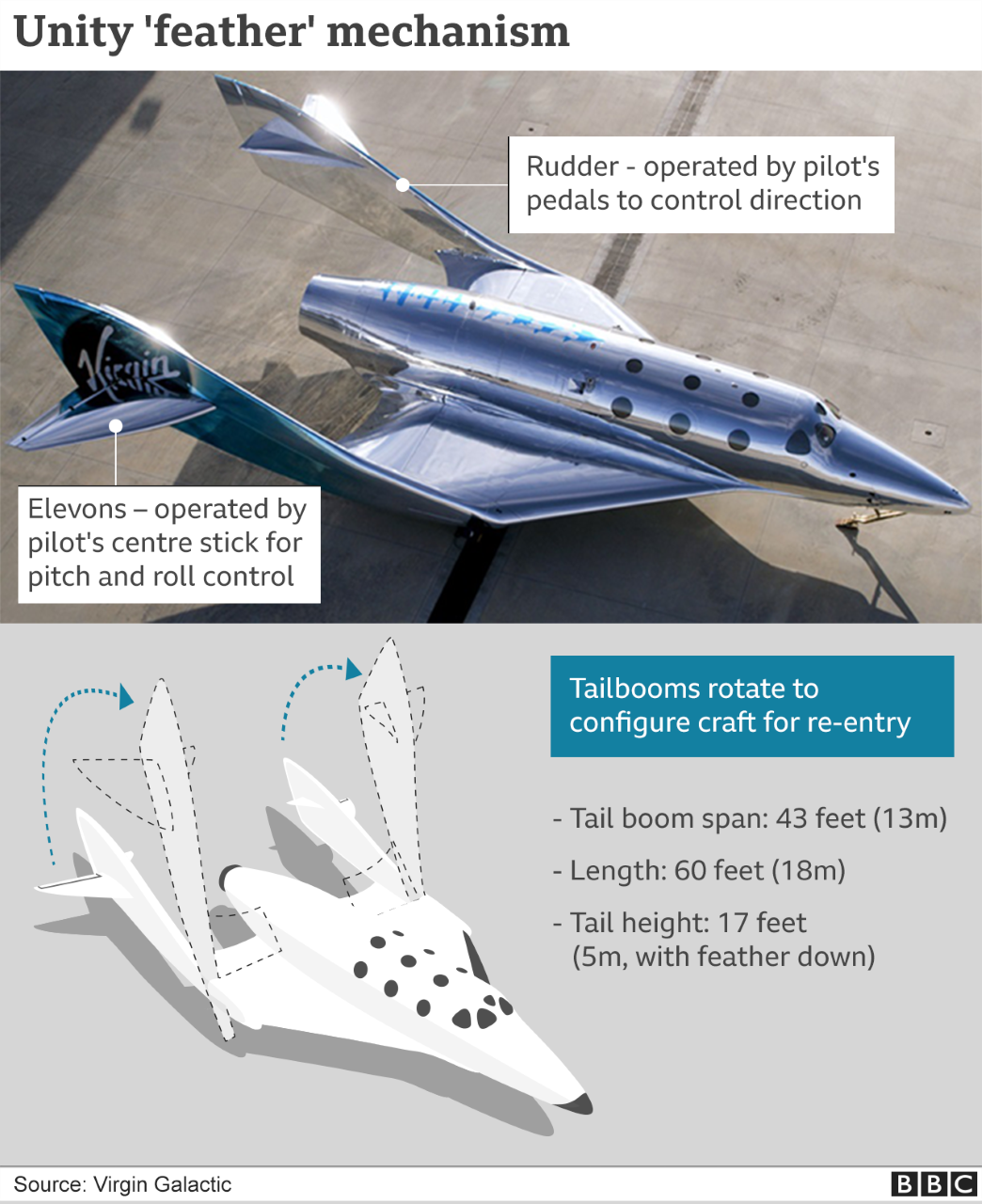
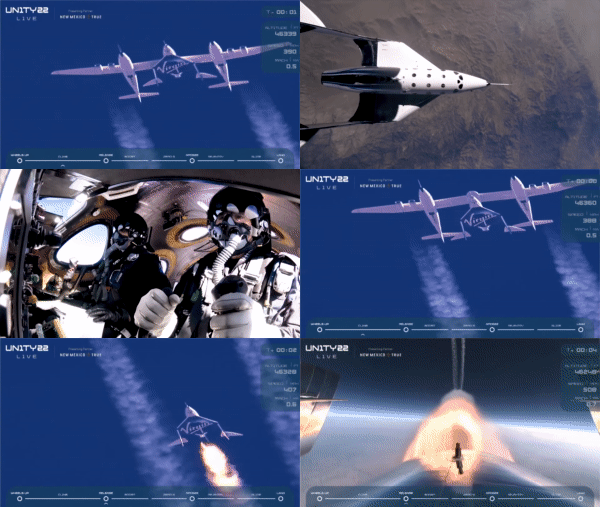
Phase 1: During the first phase of the trip, the VSS Unity hitches a ride on a twin fuselage carrier jet and is taken up to an altitude of almost 15 kilometers. As soon as it hits this altitude, the Spacecraft disengages from the mother-ship, igniting its rocket engines and proceeds to do a nearly vertical climb at almost 4000Kmph for approximately 90 seconds to get to the edge of space.
Phase 2: On its way back from the outer atmosphere, right before re-entry, the pilots engage the feather system on the space craft. This results in the wings folding up, and the sleek craft changing its airplane-type body shape to a slightly awkward one as shown in the above illustration. The reason why this is done is that by virtue of its new body shape, the craft achieves what is called ‘Shuttlecock stability’. For the folks who’ve played badminton, this might ring a bell. If you take a shuttlecock and throw it in the air, no matter what speed or angle it is thrown at, it will always self-right itself, and come down on the cork base, with the feather-side up. So in this form, aerodynamically the spacecraft resembles a self-orienting capsule system. This means the spacecraft now has a bigger tolerance on the angle and speed at which it can re-enter back into the earth’s atmosphere knowing that due to the feather system, it can always re-orient itself. This re-orienting also allows the craft to efficiently distribute friction heat across its belly in a uniform manner, as opposed to a traditional winged craft where there will be certain focal points getting extremely hot.

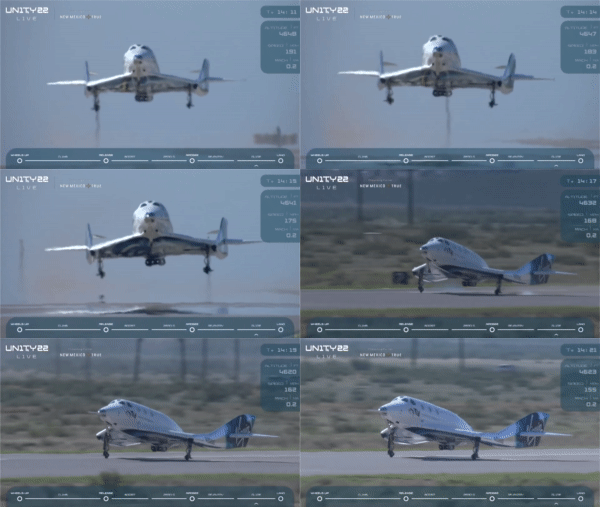
Phase 3: Post re-entry, once the spacecraft has decelerated to a manageable speed, the pilots would then disengage the feather and retract it back to the winged position, allowing the spacecraft to regain its airplane like shape. This will enable the craft to glide and make a controlled approach to the pre-determined landing strip, and make a safe landing much like a winged space shuttle.
Conclusions
Although Virgin Galactic is not the first company to use feathered re-entry, they are the first to have implemented it via the innovate rotating Feather system, certainly taking things to the next level. While the article was being written we’ve also had the following things happen:
- Jeff Bezos and Blue Origin followed-up with their own space flight in their New Shepherd spacecraft. Unlike Unity, the re-entry was in a capsule form with 6 parachutes aiding its descent.
- Many experts have questioned whether the Unity flight could actually be considered as Space flight. This is because of the lack of standard definition of Space. As per the US Air Force, Space is at a height above 80KM which Branson’s flight did achieve. However the most widely accepted definition of Space is beyond the Karman line which lies at 100 KM above the earth. This unfortunately VSS unity did not get to, as its achieved height was a little over 82.7KM (Bezos’ flight however did manage to go above the Karman line).
- There are also opinions that the Feather system may work as efficiently only for sub-orbital flights, and may not be sufficiently stable on a full-fledged orbital re-entry.
Even with all the ongoing debates surrounding the flight and the feather system, I still firmly believe this is quite a feat of technology what Virgin Galactic has achieved. My hope is for this to kickstart a whole new revolution in privatized space travel (and probably 20 years down the line, it may be cheap enough for me to afford :D).
References
- https://en.wikipedia.org/wiki/Atmospheric_entry#Feathered_reentry
- https://space.stackexchange.com/questions/1854/what-is-feathering
- https://www.faa.gov/about/office_org/headquarters_offices/avs/offices/aam/cami/library/online_libraries/aerospace_medicine/tutorial/media/iii.4.1.7_returning_from_space.pdf
- https://www.youtube.com/watch?v=6VuCzjGhcao
- https://www.youtube.com/watch?v=eEmLOU8zTSE
Thanks.